What Is Progressive Overload (and Why Women Benefit Big Time From It)?

on Aug 12, 2025
This post may contain affiliate links. Please see our disclosure policy for more details.
If you’ve ever felt stuck doing the same workouts week after week but not seeing more strength, muscle tone, or stamina… you’ve bumped into a common fitness plateau. The solution? Progressive overload — a simple, science-backed principle that helps you keep making progress in the gym (or your living room) over time.
Progressive overload is the gradual increase of stress placed on the body during exercise. In other words, you keep challenging your muscles a little more each session or over a period of weeks so they adapt, grow stronger, and more capable.
Why Progressive Overload Matters for Women
Women often shy away from “lifting heavier” or “pushing harder” out of fear of bulking up, but here’s the truth:
- Strength training helps preserve and build lean muscle, which increases metabolism and makes everyday tasks easier.
- Bone density improves when muscles are challenged — key for reducing osteoporosis risk as we age.
- Confidence skyrockets when you realize you can lift a weight you never thought possible or complete a workout that once felt impossible.
- For moms, athletes, and women in any season of life, progressive overload means your workouts don’t just maintain your fitness — they improve it.
How to Apply Progressive Overload
You don’t have to overhaul your program to make it work. Progressive overload can happen in several ways:
- Increase the weight you lift.
Example: If you’re squatting 20 lbs for 10 reps, try 25 lbs next week. - Increase repetitions with the same weight.
Example: Push-ups — last week you did 8 per set, this week you go for 10. - Increase the sets you perform.
Example: Instead of 3 sets of lunges, you do 4. - Slow down the tempo to create more time under tension.
Example: Lower into a squat for 4 seconds before standing back up. - Shorten rest time between sets to challenge your endurance.
Example: Drop your rest from 90 seconds to 60 seconds between sets.
How to Apply Progressive Overload Inside CrossFit Programming
If you’ve been following SFM workouts, we do a variation of at home CrossFit style workouts. You can find them all HERE. Here’s how you can apply progressive overload inside that programming so you’re not just “working out” — you’re intentionally getting stronger, faster, and fitter over time.
Do specific lifts before the WOD (e.g., back squat, deadlift, push press).
Progressive Overload Approach:
- Write down your weight, sets, and reps every time you lift.
- Aim to increase weight OR reps when that lift comes up again.
- Example:
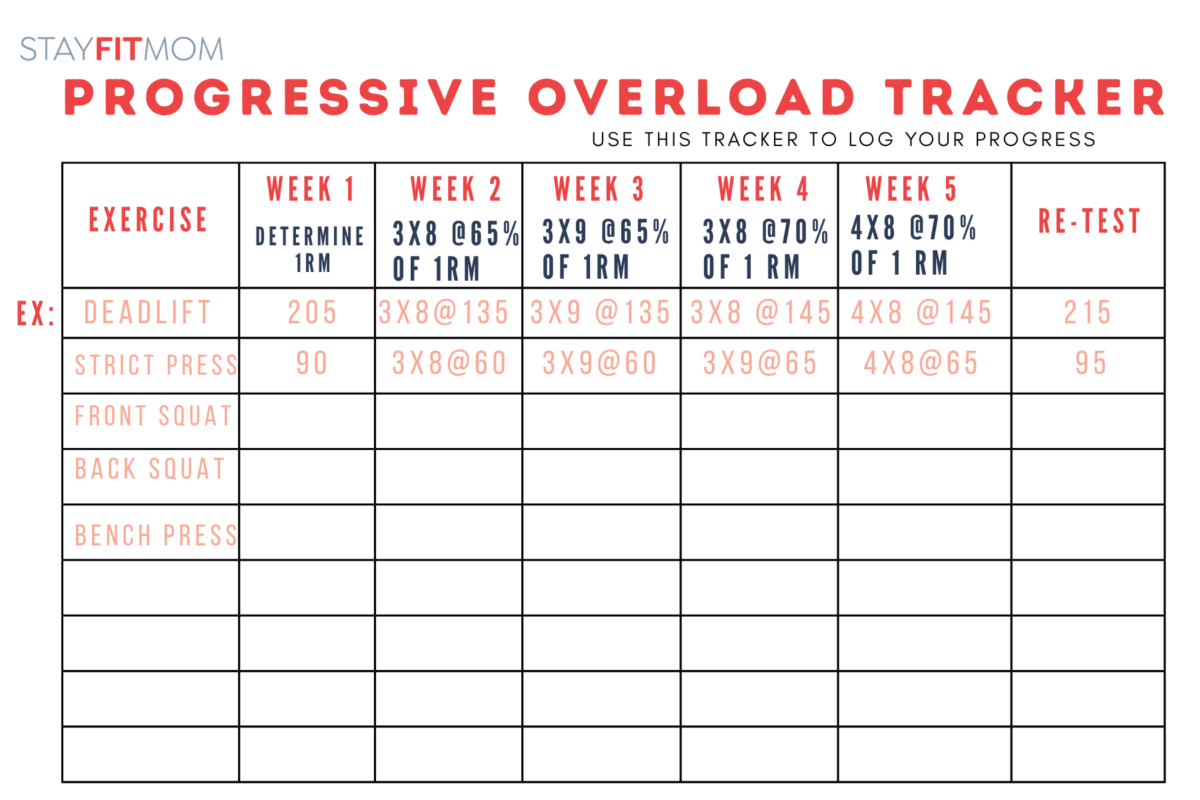
- Week 1 baseline: Determine your 1 Rep Max for Deadlift, Front Squat, and Strict Press
- Week 2: Deadlift-– 3×8 @ ~65% of your 1RM, Front Squat – 3×8 @ ~65% of your 1RM, Strict Press – 3×8 @ ~65% of your 1RM
- Week 3 Increase Reps: Deadlift – 3×9 @ same weight as Week 2, Back Squat – 3×9 @ same weight as Week 2, Strict Press – 3×9 @ same weight as Week 2
- Week 4 Increase Weight: Deadlift – 3×8 @ ~70% of your 1RM Back Squat – 3×8 @ ~70% of your 1RM, Strict Press – 3×8 @ ~70% of your 1RM
- Week 5 Add a set: Deadlift – 4×8 @ same weight as Week 4 , Back Squat – 4×8 @ same weight as Week 4, Strict Press – 4×8 @ same weight as Week 4
- Week 6 RETEST: Determine your 1Rep Max for Deadlift, Front Squat, and Strict Press
- Repeat Workouts and Try and Beat Your Score
- Level Up Gymnastics Skills: Skills like pull-ups, handstand push-ups, and toes-to-bar require consistent overload to improve.
- Progressive Overload Approach: Increase difficulty:
- Strict pull-ups → weighted pull-ups
- Knee push-ups → regular → deficit push-ups
- Progressive Overload Approach: Increase difficulty:
- Increase volume: Add 1–2 reps to each set weekly.
Download your own Progressive Overload Tracker

Other Sample Progressive Overload Workouts
Dumbbell Full-Body Strength
- Goblet Squat — 3 sets of 10 reps (progress: add weight or a set)
- Dumbbell Bench Press — 3 sets of 8 reps (progress: add reps or slow tempo)
- Bent-Over Rows — 3 sets of 10 reps (progress: heavier dumbbells)
- Plank Hold — 3 sets of 30 seconds (progress: add 5–10 seconds each week)
Bodyweight Circuit (Home-Friendly)
- Push-Ups — 3 sets of 8 (progress: add reps or elevate feet)
- Step-Ups (on sturdy chair/bench) — 3 sets of 12 per leg (progress: hold weights)
- Glute Bridges — 3 sets of 15 (progress: pause at top for 3 seconds)
- Mountain Climbers — 3 sets of 30 seconds (progress: increase speed or duration)
EMOM (Every Minute on the Minute) Challenge
Set a timer for 10 minutes. At the start of each minute:
- 5 Burpees
- 10 Kettlebell Swings
- 15 Air Squats
(Progress: increase weight, add 1–2 reps per move, or extend to 12–15 minutes)
Final Thoughts
Progressive overload isn’t about making massive jumps overnight — it’s about small, steady increases that add up to huge changes in strength, fitness, and confidence. For women especially, it’s one of the best tools for breaking plateaus, building lean muscle, and supporting long-term health.
If your workouts feel stagnant, try adding just one progressive overload strategy this week — you might be surprised how quickly your body responds.
You’re stronger than you think and progressive overload is how you prove it to yourself!
Grab your own PDF Progressive Overload Tracker HERE.