How to Hit Your Protein Goals Without Going Over Your Calories

on Oct 19, 2026
This post may contain affiliate links. Please see our disclosure policy for more details.
Eating more protein is great advice. But what happens when you’re hitting your protein goal AND consistently going over your calories?
If you’ve spent any time on social media lately, you’ve probably heard someone tell you to eat more protein.
Want to lose weight? Eat more protein.
Want to build muscle? Eat more protein.
Want to feel fuller throughout the day? Eat more protein.
And while I’m a HUGE advocate for prioritizing protein, there’s something missing from this conversation.
It’s not just about eating MORE protein. It’s about learning how to eat ENOUGH protein while staying within your calorie goals.
Because here’s the thing: You can eat 140 grams of protein every single day and still consume more calories than your body needs.
On the flip side, you might be trying to stay within a calorie deficit and find yourself struggling to get anywhere close to your protein goal.
Both situations are incredibly common, and both are exactly why understanding your macros can be so helpful.
Let’s talk about how to make protein work FOR you instead of simply adding more food to your day.
Table of Contents
- Why Protein Matters (Especially for Women)
- The Missing Piece: Protein Still Has Calories
- Not All Protein Sources Are Equal
- 6 Practical Ways to Hit Your Protein Without Blowing Your Calories
- What If You’re Hitting Your Calories but NOT Your Protein?
- You Don’t Need to Eat Perfectly. You Need a Plan.
- Let Us Help You Make Protein Easier
Why Protein Matters (Especially for Women)
First, let’s establish something important: Protein deserves the attention it’s getting!
Protein plays a significant role in:
- Building and maintaining muscle mass. This becomes increasingly important as we age, especially for women approaching perimenopause and menopause.
- Supporting recovery. Whether you’re lifting weights, chasing kids, or staying active throughout the day, protein helps your body repair and recover.
- Keeping you satisfied. Protein generally helps with fullness, which can make managing hunger and sticking to calorie goals easier.
- Preserving muscle during weight loss. When you’re eating in a calorie deficit, adequate protein combined with resistance training helps your body hold on to more lean muscle.
But here’s where I think the messaging gets confusing.
When we tell women to “eat more protein,” they often start ADDING protein to whatever they’re already eating.
A protein shake here. A handful of nuts there. A protein bar after lunch. Maybe some extra peanut butter because, hey, it has protein!
Before you know it, you’ve added several hundred calories to your day.
And if your goal is fat loss, those additional calories matter.
The Missing Piece: Protein Still Has Calories
Let’s talk about something simple but important.
Every macronutrient provides calories.
- Protein: 4 calories per gram
- Carbohydrates: 4 calories per gram
- Fat: 9 calories per gram
That means if your protein goal is 140 grams per day, you’re consuming approximately 560 calories from protein alone.
If your daily calorie target is 1,800, that leaves approximately 1,240 calories for carbohydrates and fats.
And that’s a GOOD thing! Your body needs all three macronutrients.
The goal isn’t to eat as much protein as humanly possible. It’s to eat an appropriate amount of protein while making room for the other nutrients your body needs.
More protein isn’t automatically better if it consistently pushes you beyond your calorie needs.
This is especially important if you’re trying to lose body fat.
While adequate protein helps preserve muscle and manage hunger, a calorie deficit is still necessary for fat loss.
You can’t ignore your overall calorie intake simply because the foods you’re eating are high in protein.
Not All Protein Sources Are Equal
This might be one of the biggest things I wish more women understood.
Just because a food CONTAINS protein doesn’t necessarily mean it’s an efficient protein source.
Take peanut butter, for example.
Two tablespoons of peanut butter contain approximately:
- 190 calories
- 7 grams of protein
- 16 grams of fat
Now compare that with a cup of plain nonfat Greek yogurt:
- 130 calories
- 23 grams of protein
- 0 grams of fat
Both foods contain protein. Both can absolutely fit into a healthy diet.
But if you’re trying to reach a higher protein goal without going over your calories, Greek yogurt is going to give you significantly more protein for fewer calories.
This is what I like to call getting more protein bang for your calorie buck.
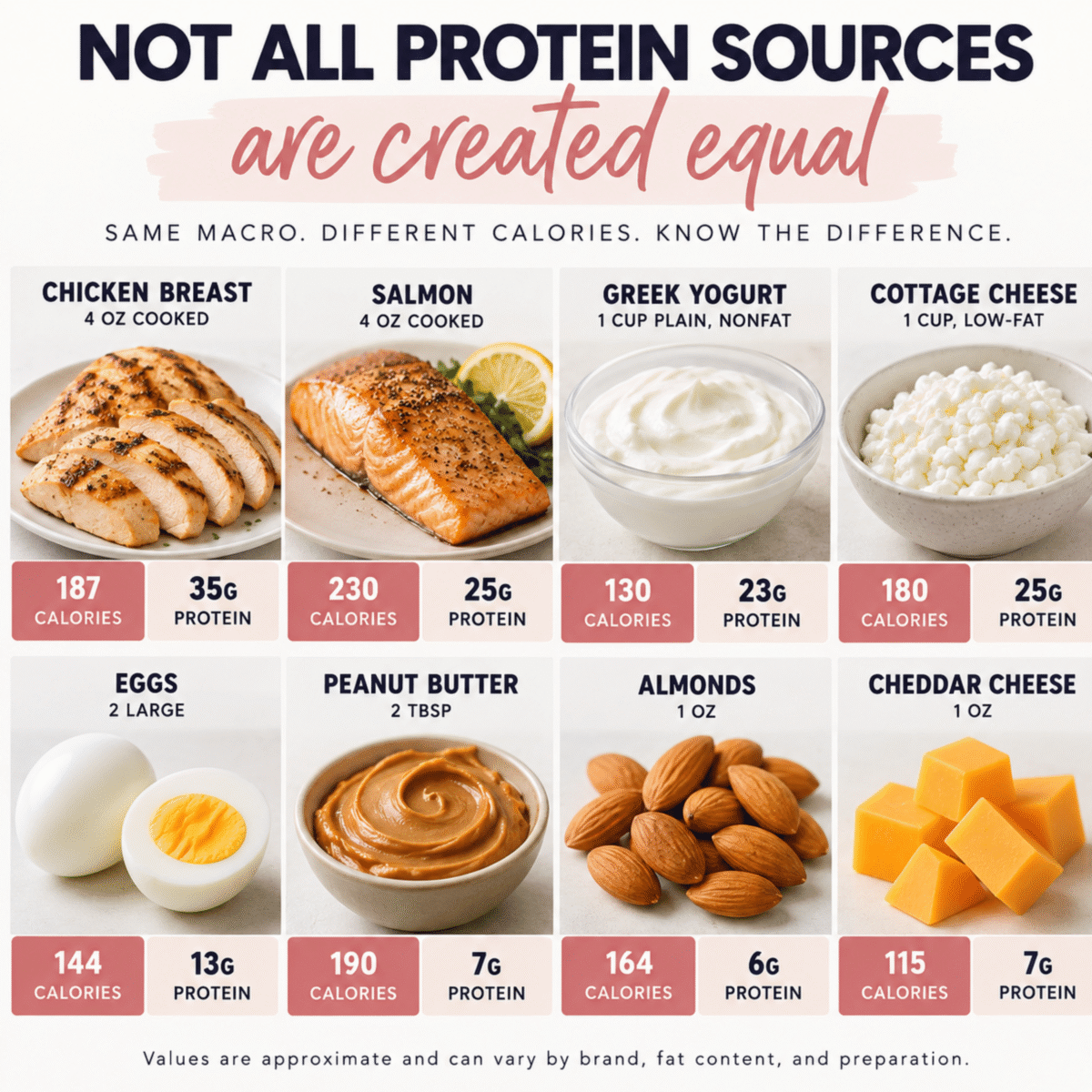
Values are approximate and vary by brand, fat content, and preparation.
Notice how quickly the calories can add up with certain foods that we commonly think of as protein sources.
This doesn’t mean you should stop eating peanut butter, nuts, cheese, or salmon. These foods provide valuable nutrients, including healthy fats.
It simply means we need to recognize what each food is contributing to our overall nutrition.
Peanut butter is primarily a fat source that contains some protein. Chicken breast is primarily a protein source.
Understanding the difference can make hitting your macros so much easier.
6 Practical Ways to Hit Your Protein Without Blowing Your Calories
1. Stop Adding Protein. Start Swapping for It.
This is probably my favorite tip.
Instead of looking at your current diet and asking, “What can I add to get more protein?” try asking:
“What can I swap to get more protein without significantly increasing my calories?”
For example:
- Swap regular yogurt for a higher-protein Greek yogurt.
- Replace some whole eggs with egg whites in your breakfast scramble.
- Choose lean ground beef or ground turkey instead of a higher-fat version when it makes sense for the recipe.
- Use Greek yogurt in place of some sour cream or mayonnaise.
- Choose a higher-protein snack instead of adding an entirely new snack to your day.
These little swaps can add up to a significant increase in protein without requiring you to eat more food.
And no, you don’t need to make every single swap every single day.
It’s about having options!
2. Build Your Meals Around Protein FIRST
One of the biggest mistakes I see women make is waiting until the end of the day to figure out how they’re going to hit their protein.
They eat breakfast, grab lunch, have a snack, and then open their tracking app at 6 p.m. to discover they still need 70 grams of protein.
Sound familiar?
Instead, start planning your meals with protein in mind.
Before you decide what else is going on your plate, ask yourself:
“Where is my protein coming from?”
Maybe it’s eggs and egg whites at breakfast, chicken at lunch, and lean beef at dinner.
Once you’ve established your protein source, build the rest of your meal around it with carbohydrates, vegetables, and fats.
This simple shift can make an enormous difference.
3. Spread Your Protein Throughout the Day
If your protein goal is 140 grams per day, you don’t need to get 100 grams of it at dinner.
In fact, spreading your protein throughout the day is often much easier and can help support muscle protein synthesis.
Here’s what 140 grams of protein could look like:
- Breakfast: 30 grams
- Lunch: 40 grams
- Afternoon Snack: 25 grams
- Dinner: 45 grams
Total: 140 grams
Of course, your exact protein needs will vary depending on your body, goals, and activity level.
The point is to make your daily goal manageable by breaking it into smaller targets.
Suddenly, 140 grams doesn’t seem nearly as intimidating.
4. Pay Attention to Protein AND Calories on Food Labels
Food marketing can be tricky.
Just because something says “HIGH PROTEIN” on the front of the package doesn’t mean it’s automatically the best choice for your goals.
A protein bar might contain 20 grams of protein, but it could also contain 300 calories.
Another option might give you 20 grams of protein for 180 calories.
Neither is necessarily a bad choice, but depending on your calorie needs, one may be a better fit.
I encourage women to start looking at both numbers together.
Ask yourself:
“How much protein am I getting for the calories I’m spending?”
Think of your calories like a daily budget.
You don’t need to spend every calorie on protein, but you do want to be intentional about where those calories are going.
5. Don’t Forget About the Extras
Sometimes it’s not the protein source that’s pushing you over your calorie goal.
It’s everything you’re adding TO it.
Chicken breast is a fantastic lean protein source. But when you add several tablespoons of oil, a creamy sauce, a generous handful of cheese, and a large portion of dressing, the calories can climb quickly.
And I’m not saying you shouldn’t enjoy those things!
You can.
But when you’re trying to stay within a calorie target, those additions need to be accounted for.
A tablespoon of olive oil contains approximately 120 calories.
Two tablespoons of ranch dressing might add another 120–150 calories, depending on the brand.
Those calories aren’t bad. They’re just part of the bigger picture.
This is why tracking your macros, even temporarily, can be such an eye-opening experience.
It helps you understand where your calories are coming from and how to make adjustments without feeling like you have to give up the foods you love.
6. Have High-Protein Meals Ready to Go
I couldn’t write this post without talking about meal prep!
One of the easiest ways to hit your protein goal consistently is to stop leaving it up to chance.
When you have meals already prepared with 30, 40, or even 50 grams of protein, you’re setting yourself up for success before the day even begins.
And this doesn’t mean eating plain chicken, rice, and broccoli every day.
At Stay Fit Mom, we create meals that are high in protein, macro balanced, and actually taste GOOD.
Think hearty Breakfast Burritos, Chicken Parmesan Meatball Bowls, Slow Cooker Beef and Broccoli, and family-friendly casseroles.
The best part? Our recipes include calories and macros, and many are already loaded into MyFitnessPal and MacrosFirst to make tracking easier.
You don’t have to do all the math yourself.
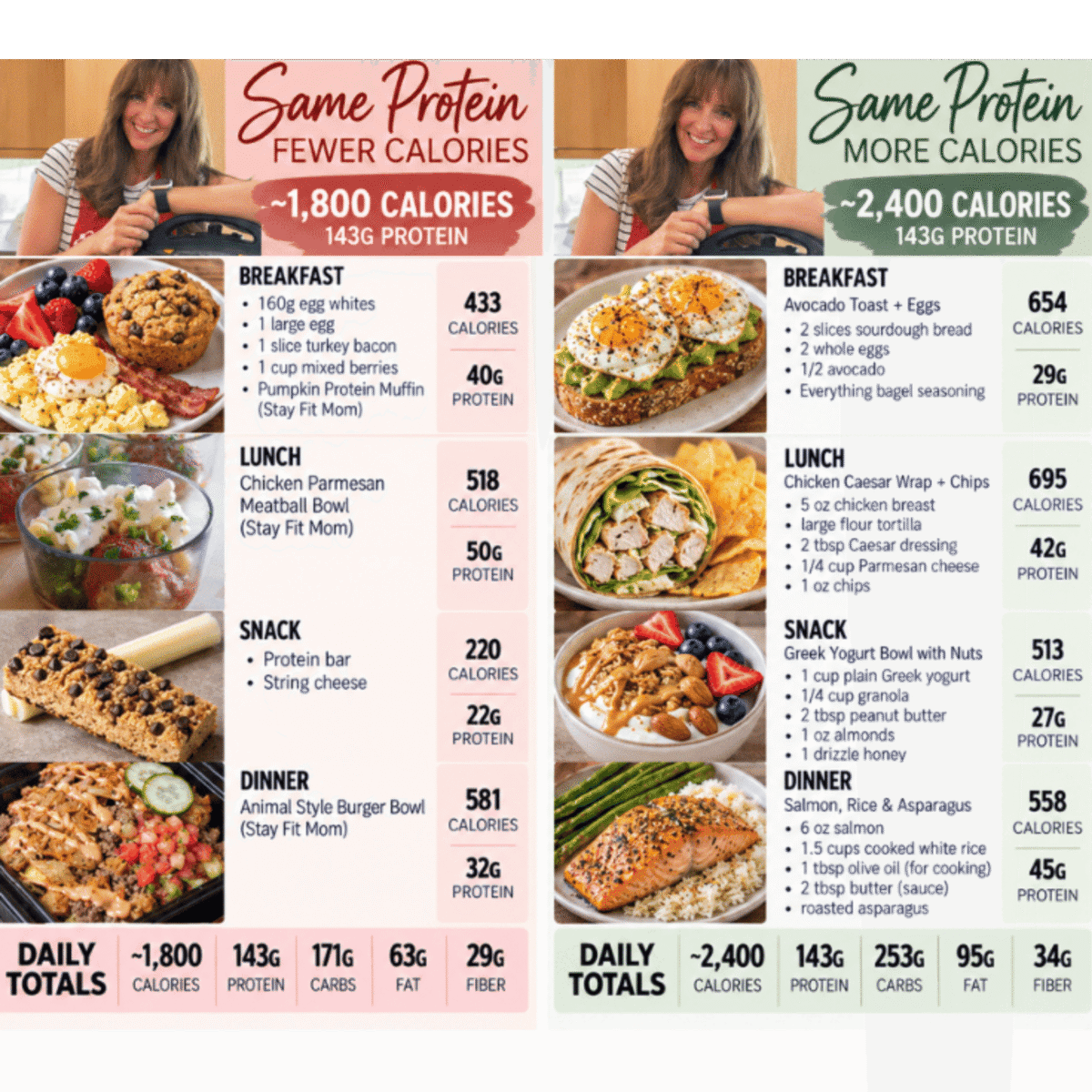
What If You’re Hitting Your Calories but NOT Your Protein?
Let’s talk about the opposite problem.
Maybe you’re doing a great job staying within your calorie target, but you’re consistently falling 30, 40, or even 50 grams short on protein.
This is where I want you to look at how you’re distributing your calories.
Are you eating a breakfast that’s mostly carbohydrates with very little protein?
Are you having a salad for lunch but only adding a couple of ounces of chicken?
Are most of your snacks coming from foods that contain very little protein?
You might not need more calories. You might simply need to redistribute the calories you’re already eating.
For example, instead of a breakfast consisting of toast and fruit alone, you could include eggs, egg whites, or Greek yogurt.
Instead of a salad with a small sprinkle of chicken, increase your lean protein portion and adjust some of the higher-calorie toppings if necessary.
Instead of grabbing a handful of nuts as your afternoon snack, consider cottage cheese, Greek yogurt, or another protein-rich option.
These aren’t rules. They’re examples of how small changes can make a big difference.
And if you’re consistently hungry, struggling with recovery, or finding it nearly impossible to reach your protein goal within your calorie target, it’s also worth evaluating whether your calorie target is appropriate in the first place. If you’re unsure of what your macros should be. Click HERE and we’ll set them for you.
Your goal should be to nourish your body, not to eat as little as possible.
You Don’t Need to Eat Perfectly. You Need a Plan.
Here’s what I really want women to understand.
You don’t need to eat chicken breast at every meal.
You don’t need to eliminate peanut butter.
You don’t need to avoid carbs or fats.
And you certainly don’t need to turn every single food you eat into a protein-packed version of itself.
You just need to understand how your food choices work together.
Sometimes that means choosing a leaner protein source at lunch because you know you’re having salmon for dinner.
Sometimes it means enjoying your favorite full-fat cheese and balancing it with lower-fat foods elsewhere in your day.
Sometimes it means choosing a recipe that’s already macro balanced so you don’t have to think so hard about it.
That’s the beauty of understanding macros.
It gives you flexibility.
Let Us Help You Make Protein Easier
If you’ve been trying to “eat more protein” but feel frustrated because you’re either going over your calories or constantly falling short of your protein goal, you’re not alone.
This is exactly the kind of thing we help women work through at Stay Fit Mom.
Our 1:1 Macro Coaching program helps take the guesswork out of nutrition. We help you establish realistic calorie and macro goals, learn how to build balanced meals, and make adjustments that fit your lifestyle.
And if you’re looking for practical ways to get more protein on your plate, our meal prep cookbooks and macro-friendly recipes are a great place to start.

Because eating enough protein shouldn’t mean blowing your calorie goals.
And staying within your calories shouldn’t mean sacrificing the protein your body needs.
The goal is to learn how to do BOTH.
And once you understand how, healthy eating becomes a whole lot less complicated.